Europe's Largest Startup Campus, in a Former Rail Freight Depot
The 34,000-square-metre Halle Freyssinet opened as Station F in June 2017, turning a disused Paris rail freight terminal into the largest startup campus in the world.
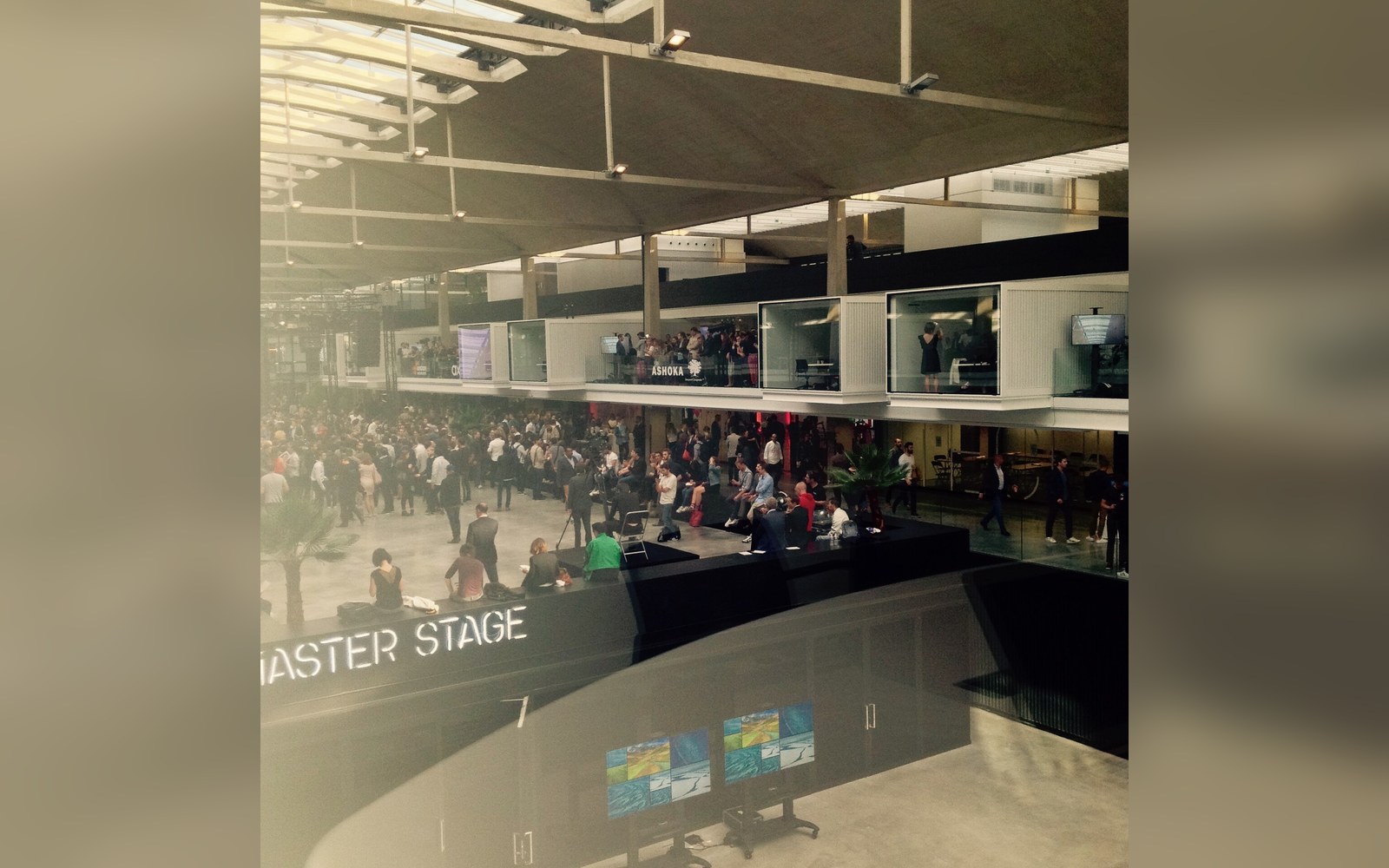
01 / AddressesFrom Freight to Founders
The Halle Freyssinet stands in the 13th arrondissement of Paris, a few hundred metres from the Gare d'Austerlitz. Eugène Freyssinet, the French structural engineer, built it between 1927 and 1929 as a covered rail freight terminus; it remained in railway use, intermittently, for the better part of a century. By the 2000s the structure had been empty for years and was listed as a historic monument — a designation that complicated any renovation but also protected the vast, arched concrete nave that gives the building its scale.
Xavier Niel, the founder of the French telecoms group Iliad, bought the right to develop the site and financed the renovation personally, committing a reported €250 million. The architect in charge was Jean-Michel Wilmotte. The project retained the original Freyssinet arches and the building's industrial bones while fitting out three parallel aisles with co-working desks, private offices, event space and a food hall. The campus stretches roughly 310 metres in length — about three football pitches end to end.


Station F opened in June 2017 as a membership-based campus capable of hosting more than 1,000 startups simultaneously. Residency is programme-based rather than simply rented: companies apply to one of the on-site accelerator programmes, of which there were more than thirty active in the campus's first years. Operators included Facebook, Microsoft, Ubisoft and the venture arm of L'Oréal, alongside French programmes run by HEC Paris and BpiFrance, the state investment bank. Y Combinator ran a European edition of its programme out of Station F for a period, a marker of how quickly the campus acquired international standing.
The French government treated the opening as a pillar of its broader technology strategy. The Tech.gouv framework — the administration's rubric for digital transformation and innovation policy — pointed to Station F as evidence that Paris could compete with London's Silicon Roundabout and Berlin's startup districts for European talent and capital. Emmanuel Macron, then newly inaugurated as president, appeared at the campus shortly after it opened. The French Tech visa, a fast-track residency scheme for non-EU founders and employees, was simultaneously expanded and processed in part through the campus's administrative apparatus.
By the early 2020s Station F reported that companies resident or alumni of its programmes had collectively raised several billion euros, though the campus itself does not publish verified aggregate figures. As a piece of real estate repurposed for technology enterprise, the Halle Freyssinet's conversion stands as one of the more legible examples of industrial heritage put to new economic use without demolition.