The Sock Puppet and the Warehouse: Two Ways to Spend a Billion
Pets.com and Webvan both went public within three months of each other, and both were dead within two years. The numbers in their filings explain why neither outcome was a surprise.
01 / LossesTwo IPOs, Two Implosions
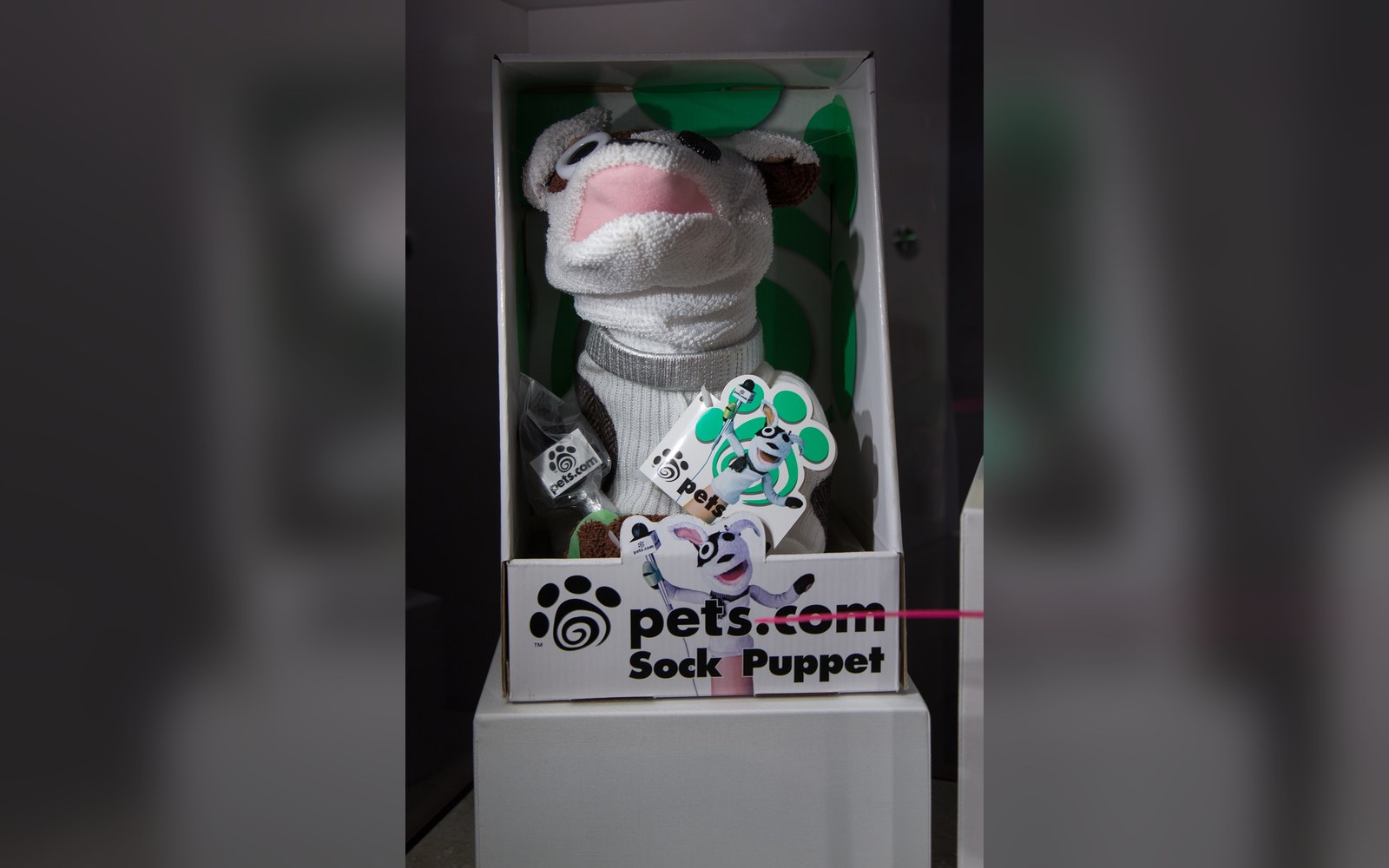
Pets.com listed on the Nasdaq on 8 February 2000 at $11 a share, raising approximately $82.5 million. Its S-1, filed with the Securities and Exchange Commission in January of that year, disclosed that the company had generated $619,000 in net revenue in its first nine months of operation against $11.8 million in operating losses. The sock puppet mascot was already a Super Bowl advertiser before the company had demonstrated any plausible path to gross margin. When Pets.com liquidated in November 2000 — nine months after the IPO — shareholders recovered essentially nothing. The company had spent more to ship a bag of dog food than it charged for the bag.
Webvan's trajectory was larger in every dimension and correspondingly more instructive. The online grocery delivery company raised $375 million in its November 1999 IPO — one of the largest internet IPOs of the year — having disclosed in its S-1 losses of approximately $35 million in the first half of 1999 alone. Before going public, Webvan had committed to a $1 billion contract with Bechtel to build a national network of automated warehouses. The company planned to enter twenty-six cities on a timeline derived from a business plan, not from evidence that any single market worked. Quarterly SEC filings from 2000 show burn rates reaching roughly $100 million per quarter by mid-year. Webvan filed for Chapter 11 bankruptcy in July 2001 and was liquidated shortly thereafter.

02 / LossesWhat the Investors Received

The investor record is unambiguous. Bowman Capital backed Pets.com alongside Hummer Winblad Venture Partners and Amazon, which took a roughly 54 percent stake as a strategic investor. None recovered meaningful capital from the liquidation. Webvan's backers were more prominent and their losses correspondingly larger: Sequoia was again involved, as were Softbank and Goldman Sachs among the later-round participants. The IPO priced at $15; the stock was trading below $1 before the bankruptcy filing. In aggregate, Webvan burned through approximately $800 million in investor capital over less than two years of operation.
The two companies failed for related but distinct reasons. Pets.com was a unit-economics disaster from the beginning — the cost of fulfilling and shipping pet supplies ordered online exceeded the revenue those orders generated, with no credible path to reversal at any scale. Webvan's problem was sequencing: the warehouse infrastructure was built before demand was confirmed, locking capital into fixed assets that could not be recovered when growth stalled. One company spent recklessly on marketing; the other spent recklessly on operations. Both spent against a clock their investors had started by writing the checks.
The Nasdaq Composite peaked at 5,048.62 on 10 March 2000 — between Pets.com's February IPO and Webvan's collapse — and then fell roughly 78 percent over the following thirty months. Neither company's fate was solely a consequence of the market correction; both were demonstrably non-viable on their own disclosed numbers before the index turned. The S-1 filings were public documents. The burn rates were in the quarterlies. The warehouse contract was in Webvan's prospectus. What the period produced was not a shortage of information but a sustained collective decision, by underwriters, institutional investors, and retail buyers, to treat expansion velocity as a proxy for business quality.