Sand Hill Road, 1972: Two Firms, One Address, Forty Years of Returns
Two venture firms opened within months of each other on the same Menlo Park road in 1972. Between them, they helped create more market capitalisation than any comparable pair in financial history.
01 / MoneyThe Founding Structures
Eugene Kleiner and Tom Perkins established Kleiner Perkins Caufield & Byers in 1972, drawing on Kleiner's standing as one of the traitorous eight who had walked out of Shockley Semiconductor Laboratory fifteen years earlier. Perkins brought operational credibility — he had built Hewlett-Packard's computer division. Their first fund was modest by any subsequent standard: approximately $8 million raised from a small group of limited partners, structured as a ten-year closed-end partnership with a two-and-twenty fee arrangement — two percent annual management fee on committed capital, twenty percent carried interest on profits — that would become the industry template.
Don Valentine founded Sequoia Capital the same year, also on Sand Hill Road in Menlo Park, after a stint at Fairchild Semiconductor and National Semiconductor. Valentine's first fund was similarly sized, and his investment philosophy leaned harder on market scale than on the founders themselves — he is widely reported to have cared less about who was pitching than about how large the addressable market was. Both firms adopted the limited partnership structure that the Small Business Investment Act of 1958 had made commercially viable and that the 1979 ERISA clarification would later supercharge by opening pension capital to the asset class.


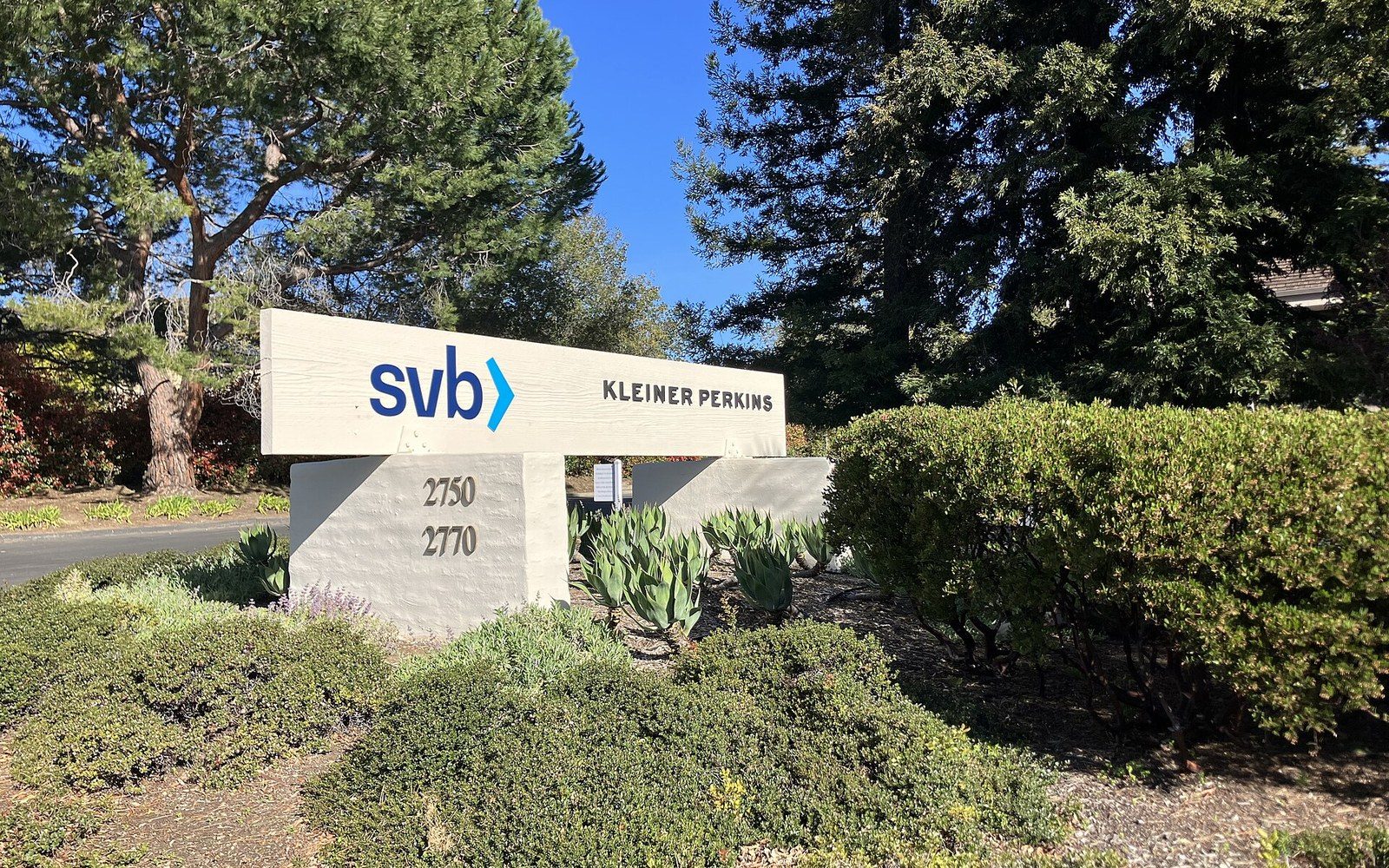
The physical address mattered as much as the legal structure. Sand Hill Road's concentration of firms meant that a company could walk from one managing partner's office to another's in under ten minutes — a geography that compressed deal timelines, accelerated syndication, and allowed term-sheet competition to function as a genuine pricing mechanism.
02 / MoneyThe Portfolio Record
The divergence between the two firms lay in style more than in returns. Kleiner Perkins moved early into biotechnology alongside computing: Genentech received its first venture backing from the firm in 1976, and the Genentech IPO in 1980 produced returns that demonstrated the model's upper bound. Later investments included Compaq, Netscape, Amazon, and Google. Sequoia's record included Apple (first round, 1978), Cisco, Yahoo, Google — alongside Kleiner on that one — Instagram, WhatsApp, and Airbnb.
PitchBook's analysis of venture fund performance by vintage year consistently places both firms among the top decile of returners across multiple fund generations spanning the 1970s through the 2000s. The precise internal rates of return for individual funds remain confidential to limited partners, but the portfolio outcomes are documented: Crunchbase data show Sequoia alone has backed companies whose aggregate public-market value has exceeded $3.3 trillion, a figure the firm itself has cited in investor materials. Kleiner Perkins's portfolio companies by the mid-2010s had a comparable aggregate.
The J-curve — the pattern in which early fund expenses and write-downs produce losses before winners are realised — operated conventionally in both firms' early funds. The characteristic that separated the top-quartile Sand Hill partnerships from their peers was not the avoidance of the J-curve but the steepness of the eventual uptick, driven by one or two investments per fund that returned multiples of the entire committed capital.
03 / MoneyForty Years On
By the time both firms marked their fortieth anniversaries, the structure of Sand Hill Road had changed in ways that complicated the clean 1972 picture. Kleiner Perkins made a well-publicised turn toward growth-stage and later-stage investing in the 2010s, and faced internal turbulence that led to the departure of several senior partners. Sequoia restructured globally and, in 2021, announced a shift away from the traditional ten-year fund model toward an open-ended structure — a significant departure from the two-and-twenty closed-end partnership that Valentine had inherited and codified.
Neither change erased the foundational record. The National Venture Capital Association's historical data identifies 1972 as the year the Sand Hill corridor crystallised as the institutional centre of American venture capital, and both firms' longevity — across semiconductor cycles, the dot-com collapse, the mobile era, and the SoftBank-inflated 2010s — is itself part of what the portfolio record demonstrates. Two firms, one address, one year: a founding coincidence whose consequences compounded for half a century.